
Tired of a Messy Downloads Folder? I Built a Python Script to Fix It Forever
Python
We’ve all been there. You look at your Downloads folder and it’s a digital graveyard. PDFs mixed wit...
205
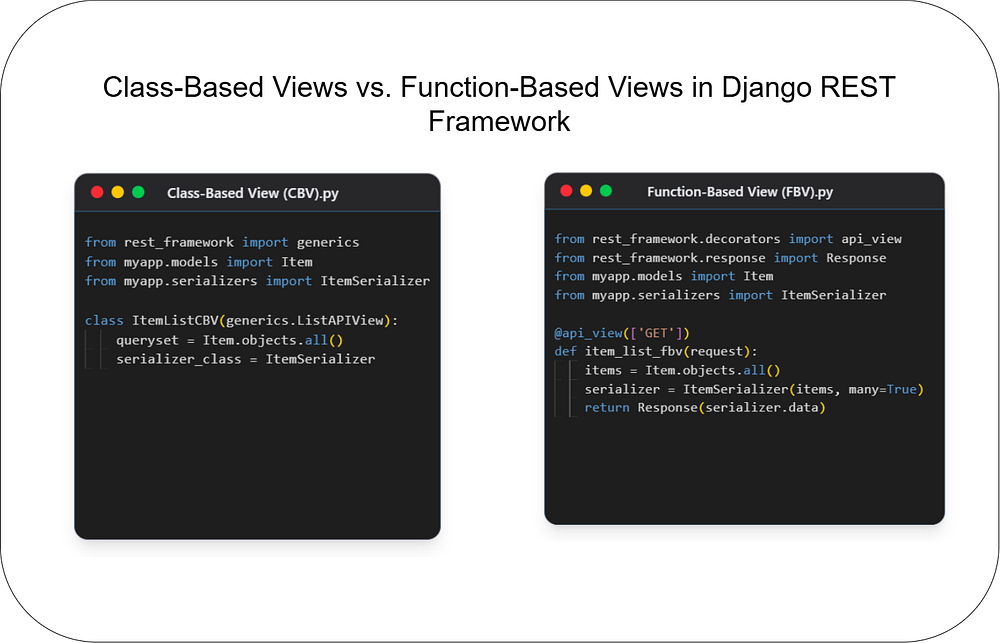
Choosing the right architecture for your API endpoints is crucial for building scalable and maintainable applications. In the Django REST Framework (DRF), you have two primary ways to define your API views: Function-Based Views (FBVs) and Class-Based Views (CBVs). As a beginner, understanding the strengths and weaknesses of each approach is essential.
In this blog post, we’ll dive deep into both FBVs and CBVs, providing clear explanations, practical examples, and guidance on when to use each.
Function-based views, as the name suggests, are Python functions that handle incoming HTTP requests and return responses. They are the more traditional way of writing views in Django, and for simple API endpoints, they can be quite straightforward.
How FBVs Work:
An FBV takes an HttpRequest object as its first argument. You then write the logic within the function to process the request based on the HTTP method (GET, POST, PUT, DELETE, etc.) and return an HttpResponse or, in the context of DRF, a Response object.
Example of FBVs:
Let’s consider a simple API endpoint to manage a list of “Tasks.”
Python
from rest_framework.decorators import api_view, permission_classes
from rest_framework.response import Response
from rest_framework import status
from rest_framework.permissions import IsAuthenticated
from .models import Task
from .serializers import TaskSerializer
@api_view(['GET', 'POST'])
@permission_classes([IsAuthenticated])
def task_list(request):
    """
    List all tasks, or create a new task.
    """
    if request.method == 'GET':
        tasks = Task.objects.filter(owner=request.user)
        serializer = TaskSerializer(tasks, many=True)
        return Response(serializer.data)
    elif request.method == 'POST':
        serializer = TaskSerializer(data=request.data)
        if serializer.is_valid():
            serializer.save(owner=request.user)
            return Response(serializer.data, status=status.HTTP_201_CREATED)
        return Response(serializer.errors, status=status.HTTP_400_BAD_REQUEST)
@api_view(['GET', 'PUT', 'DELETE'])
@permission_classes([IsAuthenticated])
def task_detail(request, pk):
    """
    Retrieve, update, or delete a specific task.
    """
    try:
        task = Task.objects.get(pk=pk, owner=request.user)
    except Task.DoesNotExist:
        return Response(status=status.HTTP_404_NOT_FOUND)
    if request.method == 'GET':
        serializer = TaskSerializer(task)
        return Response(serializer.data)
    elif request.method == 'PUT':
        serializer = TaskSerializer(task, data=request.data)
        if serializer.is_valid():
            serializer.save()
            return Response(serializer.data)
        return Response(serializer.errors, status=status.HTTP_400_BAD_REQUEST)
    elif request.method == 'DELETE':
        task.delete()
        return Response(status=status.HTTP_204_NO_CONTENT)
Pros of FBVs:
Simplicity for Basic Operations: For very straightforward tasks, FBVs can be easier to read and understand initially. The logic is often contained within a single function.
Explicit Control Flow: The execution path in an FBV is very clear and linear, which can be beneficial when you need fine-grained control over every step.
Potentially Less Overhead for Simple Cases: For very simple endpoints, the overhead of defining a class might feel unnecessary.
Cons of FBVs:
Code Repetition: As your API grows, you’ll likely find yourself repeating common patterns like handling different HTTP methods, authentication checks, permission checks, and serialization/deserialization logic in multiple functions.
Limited Reusability: Sharing common logic across different FBVs can be challenging, often leading to code duplication.
Difficult to Extend and Maintain: For complex API endpoints, FBVs can become long and hard to manage. Adding new functionality or modifying existing behavior might require significant changes within a single function.
Less Built-in Structure: DRF provides a lot of helpful tools (like mixins) that are designed to work seamlessly with CBVs, offering built-in structure for common API patterns. You’d need to implement these yourself in FBVs.
Class-based views are Python classes that inherit from Django’s View class or, more commonly in DRF, from DRF's specialized base classes and mixins. They handle different HTTP methods through distinct methods within the class (e.g., get(), post(), put(), delete()).
How CBVs Work:
When a request comes in, Django dispatches it to the appropriate method of the CBV based on the HTTP method of the request. DRF’s base classes and mixins provide a lot of built-in functionality for common API tasks.
Example of CBVs using Generic Views and Mixins:
Let’s rewrite the “Tasks” API using CBVs and DRF’s generic views and mixins:
Python
from rest_framework import generics
from rest_framework import permissions
from .models import Task
from .serializers import TaskSerializer
class TaskListCreateView(generics.ListCreateAPIView):
    """
    List all tasks for the authenticated user, or create a new task.
    """
    serializer_class = TaskSerializer
    permission_classes = [permissions.IsAuthenticated]
    def get_queryset(self):
        return Task.objects.filter(owner=self.request.user)
    def perform_create(self, serializer):
        serializer.save(owner=self.request.user)
class TaskRetrieveUpdateDestroyView(generics.RetrieveUpdateDestroyAPIView):
    """
    Retrieve, update, or delete a specific task for the authenticated user.
    """
    serializer_class = TaskSerializer
    permission_classes = [permissions.IsAuthenticated]
    def get_queryset(self):
        return Task.objects.filter(owner=self.request.user)
Notice how much less code we had to write compared to the FBV example! DRF’s ListCreateAPIView and RetrieveUpdateDestroyAPIView handle the logic for listing, creating, retrieving, updating, and deleting objects, respectively. We simply needed to specify the serializer and queryset.
Pros of CBVs:
DRY (Don’t Repeat Yourself): CBVs, especially when used with DRF’s mixins and generic views, promote code reuse. You inherit functionality for common API operations.
Better Organization and Structure: CBVs naturally lead to a more organized codebase, especially for complex APIs. The separation of concerns based on HTTP methods makes the code easier to navigate.
Extensibility and Maintainability: It’s generally easier to extend the functionality of CBVs by overriding methods or using mixins. This makes the codebase more maintainable as your API evolves.
Leveraging DRF’s Power: DRF provides a rich set of generic views and mixins that handle a lot of the boilerplate code for common CRUD (Create, Read, Update, Delete) operations.
Clearer Separation of Concerns: Different aspects of handling a request (like authentication, permissions, data validation, and business logic) can be more clearly separated within the class structure.
Cons of CBVs:
Steeper Learning Curve (Initially): Understanding the inheritance hierarchy and how mixins work can be a bit challenging for beginners initially.
Can Feel Overly Complex for Simple Tasks: For very basic endpoints, using a full-fledged class might seem like overkill compared to a simple function.
Implicit Control Flow: The flow of execution in CBVs, especially when using multiple mixins, might be less immediately obvious than in FBVs. You need to understand the method resolution order.
There’s no absolute “best” choice between FBVs and CBVs. The decision often depends on the complexity and requirements of your specific API endpoint. Here’s a general guideline:
Use Function-Based Views When:
You have very simple, highly customized API endpoints with minimal logic.
You need fine-grained control over the request-response cycle and the logic doesn’t fit neatly into standard CRUD operations.
You are building a very small API where code repetition is not a significant concern.
You are rapidly prototyping a specific piece of functionality.
Use Class-Based Views When:
You are building APIs with standard CRUD operations on resources.
You want to leverage the reusability and structure provided by DRF’s generic views and mixins.
You anticipate your API growing in complexity and want a more maintainable codebase.
You need to implement common patterns like authentication, permissions, and pagination consistently across multiple endpoints.
You want to adhere to the DRY principle and reduce code duplication.
Best Practices and Recommendations:
Start with what feels most comfortable, but be open to refactoring: If you’re new to DRF, you might start with FBVs. However, as your API grows, consider refactoring to CBVs to take advantage of their benefits.
Embrace DRF’s Generic Views and Mixins: For standard CRUD operations, DRF’s generic views and mixins are incredibly powerful and can significantly reduce the amount of code you need to write.
Combine CBVs and FBVs: It’s perfectly acceptable to use a mix of both in your project. Use FBVs for simple, highly customized endpoints and CBVs for more standard resource-based endpoints.
Prioritize Readability and Maintainability: Ultimately, the “best” approach is the one that leads to a more readable, maintainable, and scalable codebase for your specific project. For most non-trivial APIs built with DRF, class-based views are generally the preferred and recommended approach.
Understanding the differences between Function-Based Views and Class-Based Views in Django REST Framework is a crucial step in your journey as an API developer. While FBVs offer simplicity for basic tasks, CBVs provide a more robust and scalable architecture for building complex APIs by promoting code reuse and leveraging DRF’s powerful features. As you gain more experience, you’ll develop a better intuition for when to use each approach. Remember to prioritize code readability and maintainability to build APIs that are both functional and a pleasure to work with.
Found this blog post helpful? 🔥
If you enjoyed this article and found it valuable, please show your support by clapping 👏 and subscribing to my blog for more in-depth insights on web development and Next.js!
Subscribe here: click me
🚀 Follow me on:
🌐 Website: sagarsangwan.vercel.app
🐦 Twitter/X: @sagar sangwan
🔗 LinkedIn: Sagar Sangwan
📸 Instagram: @codebysagar
Your encouragement helps me continue creating high-quality content that can assist you on your development journey. 🚀

Code. Write. Build. Explore. 💻✍️ Software developer by day, mechanical tinkerer by night. When I’m not shipping code or writing blogs, you’ll find me trekking up a mountain, whipping up a feast, or hitting the open road on two wheels. Life is better in high gear.
View more blogs by me CLICK HERE
We’ve all been there. You look at your Downloads folder and it’s a digital graveyard. PDFs mixed wit...
Unlock the power of React and Next.js! This guide clarifies their key differences, ideal use cases, ...

Master JavaScript with these 10 concise and powerful one-liners. Level up your coding skills with ef...
Subscribe to get the latest posts delivered to your inbox